The method
1. Find the assumption
Name the one belief that would sink the idea if it were false, and turn it into a prediction you can test.
Before you start
- An idea, stated as a choice: "should we build X?", "should we charge Y?".
- The facts you already have: usage numbers, churn reasons, tickets, customer quotes. More context gives sharper assumptions.
Steps
List what has to be true
Ask in your AI tool Use SwiftCNS to test this: [the idea]. Context: [facts]. What does it rest on?
Open your project and describe the idea in the box on Project home, or choose New conversation. The card Select assumptions appears in the thread.
SwiftCNS replies with a handful of assumptions, each scored 1 to 5 for importance (does the idea fail without it?) and evidence (how much do you already know?). It may ask a clarifying question first.
Pick the riskiest one
Choose high importance and low evidence. One is usually enough. If two tie, pick the one the others depend on, or whose failure would cost you most. Be specific: "teams will pay $79 a month to share", not "pricing".
Pick the prediction to test
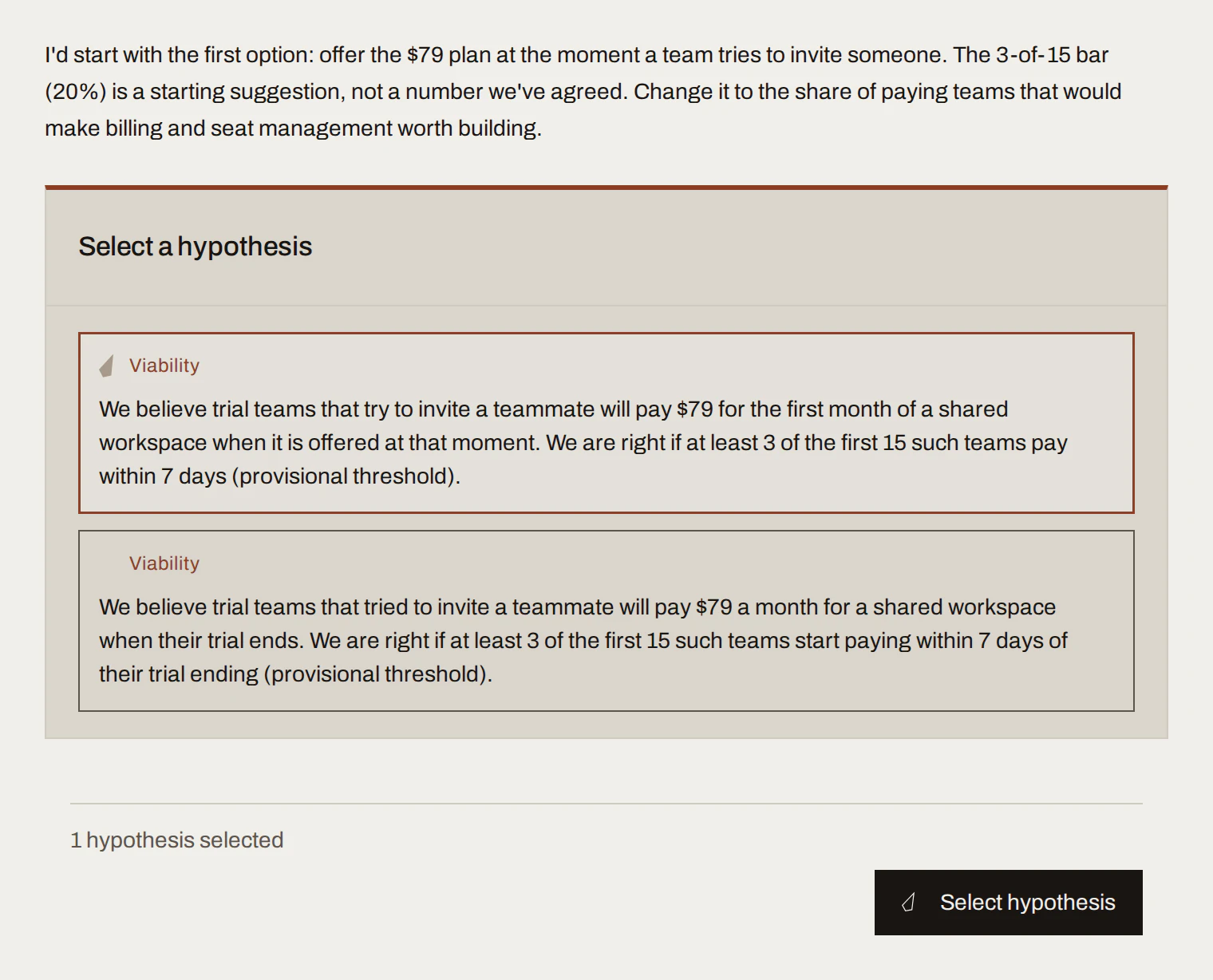
SwiftCNS turns your assumption into one or two hypotheses: a prediction plus provisional success criteria that could prove it wrong. Pick the one you can test soonest and most directly.
What you get
In the running example, four assumptions came back. The team picked the one scored importance 5, evidence 1:
- Trial teams that try to invite a teammate will pay $79 a month for a shared workspace.
The hypothesis they chose: trial teams that try to invite a teammate will pay $79 for the first month of a shared workspace when it's offered at that moment. We're right if at least 3 of the first 15 such teams pay within 7 days.
Done when
- One assumption is written specifically enough that a result could prove it false.
- You picked it because it's risky, not because it's easy to test.
Common mistakes
- Testing the fix before the cause. If you don't know why something happens, testing a solution tells you little.
- Picking what you already believe. High evidence means low learning.
- Vague wording. "Users want it" can't be missed, so it can't be tested.
For agents: MCP tools and gotchas
- Create the conversation first:
generate_resource_id(CONVERSATION), thencreate_conversation. send_message, then pollget_message. Readget_conversation_progress: the active Action Request isassumption_selection; submit withselect_assumptions(selectedAssumptionIds).- Clarifying questions arrive as
question_answer(answer_clarifying_questions). - Then
hypothesis_selectionviaselect_hypothesis. PasscontinueConversation: trueand a branch-leafparentMessageIdto get the next turn. - Choose only what the user chose, or what they explicitly delegated.
Next
How to test an idea
The four steps SwiftCNS gives every test, so your team sets success criteria up front, sees what's running and remembers why it decided.
2. Set the success criteria
Choose the experiment and agree, before anything runs, what result counts as success. Approving it fixes the criteria.