The method
2. Set the success criteria
Choose the experiment and agree, before anything runs, what result counts as success. Approving it fixes the criteria.
Before you start
- A chosen hypothesis from step 1.
- The person who will make the decision. They should agree the criteria now, not after the results.
Steps
Compare the experiment designs
Ask in your AI tool Show me the SwiftCNS experiment options with their scores and success criteria. I'll choose.
The card Select an experiment lists the designs. Open Approach and measurements on each to see how it runs and what it measures.
Each design is scored 1 to 5 for setup, run time, cost and data reliability (lower is simpler, faster, cheaper, more reliable) and comes with success criteria and key metrics.
Check the criteria before you choose
Would a miss change your mind? If not, raise the criteria or pick another design. Check the sample size and how long it will take. Don't choose on cost alone: a cheap design that measures what people say is weaker than one that measures what they do.
The experiment's success criteria are what you'll call the result against. They can differ from the provisional criteria in the hypothesis; make sure the two agree before you approve. Provisional criteria are a starting point. To change them, choose Edit experiment below the thread (or tell your AI tool) and describe the change.
Assign and approve
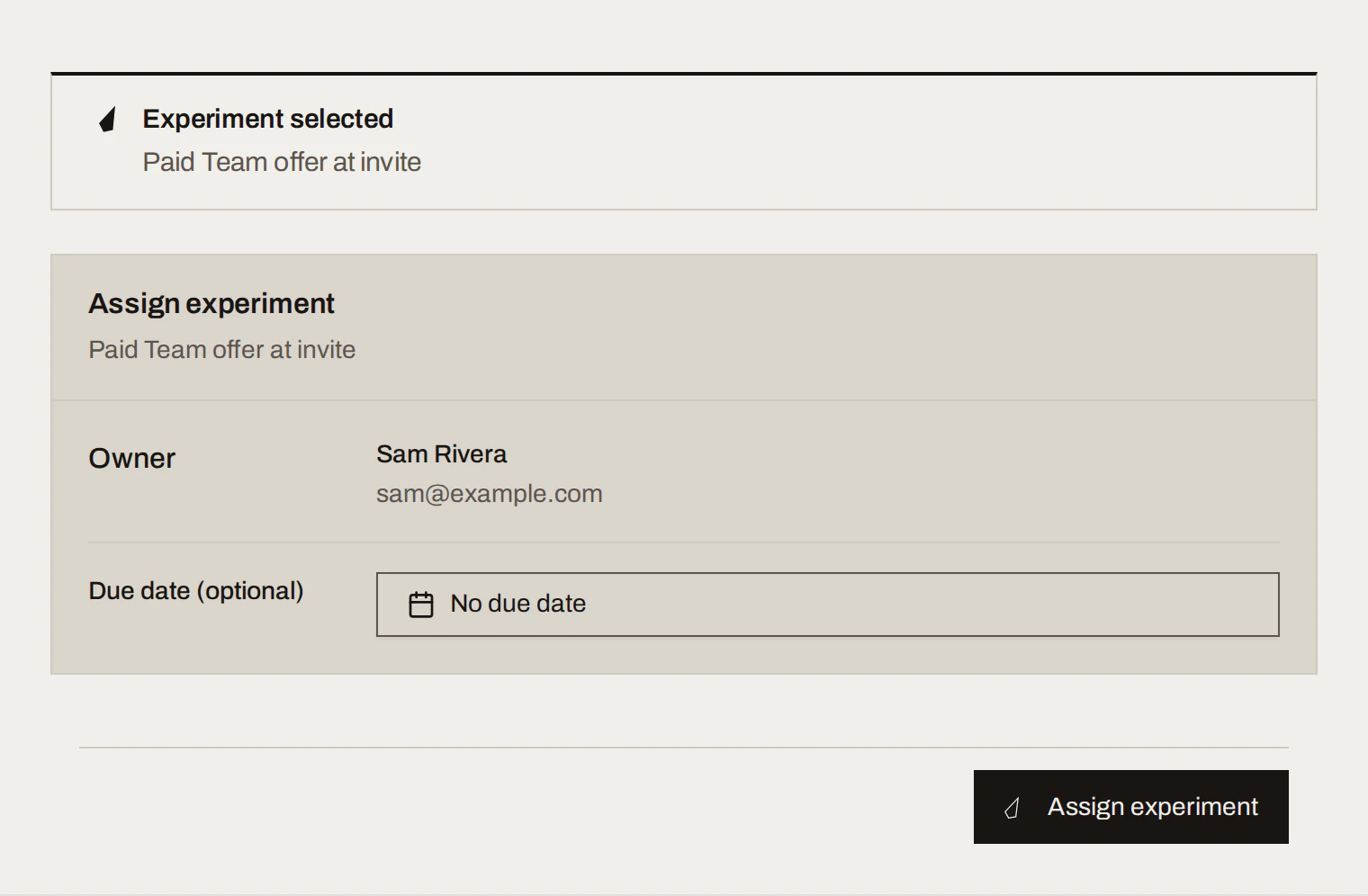
Choose an owner and, if you like, a due date, then approve. Approving commits you to this design and these success criteria. They can't be edited afterwards.
What you get
The running example offered two designs for the same hypothesis:
| Design | Trade-off |
|---|---|
| Paid Team offer at invite | Shows whether teams actually pay; needs a payment link and manual setup |
| Team plan fake-door button | Cheaper; shows interest at the price, not payment |
The team chose the paid offer, because only real payment answers the question. The criterion they approved:
At least 3 of the first 15 trial teams that see the offer pay $79 within 7 days of seeing it.
Two more metrics explain the result without deciding it: where teams drop off, and why they don't pay.
Done when
- The criterion is a number to reach, with a sample and a time window.
- The decision-maker agreed it before the experiment started.
- The experiment is approved and has an owner.
Common mistakes
- No number. "We'll see what people say" can't be missed.
- Criteria you'd ignore. If 1 in 15 would still make you build it, 3 in 15 isn't your real criterion.
- Measuring interest when you need commitment. Clicks and "I'd pay" are weaker than payment.
For agents: MCP tools and gotchas
experiment_card_selectionviaselect_experiment(selectedExperimentCardId).- Then
assign_experiment(assigneeUserPublicId, optionaldueAtin RFC 3339 with an offset, in the future). Find eligible people withlist_eligible_experiment_assignees. - Then
approve_experiment(empty submission). All three needcns:decideand returncontinuationMode: NONE. - Edits before approval:
send_messagedescribing the change, thenapply_field_edit_proposalwith atoolCallIdfromget_message→fieldEditProposals. Edits are refused once the experiment leaves draft.